|
|
|
Ideological Thinking in Politics
Shaun Kerry, M.D.
Diplomate, American Board of Psychiatry and Neurology
I can remember, from my boyhood years, my mother arguing politics with my grandfather. She was a republican. He was a democrat. They just seemed |
|
 |
|
to go round and round in circles. It was an ongoing debate in which nothing got solved.
Simply put, an ideology is a belief. A person can argue all he wants, but it is still just a belief. It is not an empirical truth. And there will always be disputes over beliefs. If, however, an idea is of a scientific nature, than it is testable. And once tested, and proven, almost everyone will come to agree with it. Galileo concluded that the earth revolved around the sun, and during his time, a lot of people were not too thrilled with this idea. But over many years, as more and more evidence arose to support his initial conclusion, people began to accept his beliefs as truth. Today, no reasonable person will disagree with the notion that the earth revolves around the sun. It has been scientifically proven.
Communism. Socialism. Capitalism. These are all words that describe ideologies. In the world today, there are a great many people who are very attached to their personal ideologies. They have accepted them as gospel, to the point where they believe that all of the world's problems could be solved, if everyone else just accepted them as well. This kind of thinking is flawed, and has no grounding in objectivity or truth. Regardless, ideologies are extremely powerful.
I know an American who was in the Viet Nam war. He murdered people, and was involved in unspeakable atrocities, by his own admission. Today, he still believes that his actions were justified because: "We had to stop communism at all costs." His destructive behavior was based on this terribly erroneous assumption. His actions were the product of his belief in an ideology that was false.
|
|
 |
|
People continue attempting to solve social problems with ideologies. This is not only ineffective, but also damaging. Granted, we are all entitled to have our own beliefs. But we need to recognize them as simply that: beliefs. Not truths.
Today, the people in political parties who select their candidates are usually ideological thinkers. They select candidates who think like they do. The general public can recognize this. With proper electoral reform, I believe that people will be able to see a clear difference between the problem solving personality and the ideological personality.
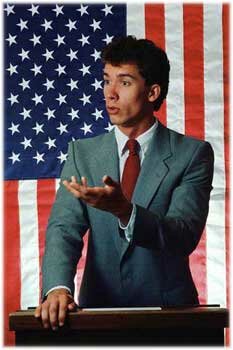
Ideological thinkers can be extremely deceptive. They may be wonderful orators. They may articulate their noble ideals
|
using beautiful words. When I hear such rhetoric, it often makes me feel very uncomfortable, because I sense that it is merely an illusion, which conceals a faulty understanding of the system, its mechanics, its flaws, and possible solutions.
When an ideological thinker is asked how he will solve a problem, he usually is evasive, responding with an answer that is overly general and superficial. Perhaps he should work in sales, but not in a position of executive responsibility. But sadly, he can often hypnotize a crowd with his oratorical ability. Fortunately, however, he can be exposed by using the proper strategy.
PRINTABLE PAGE | BACK | TOP | NEXT | PRINTABLE SITE
|
|
|